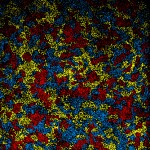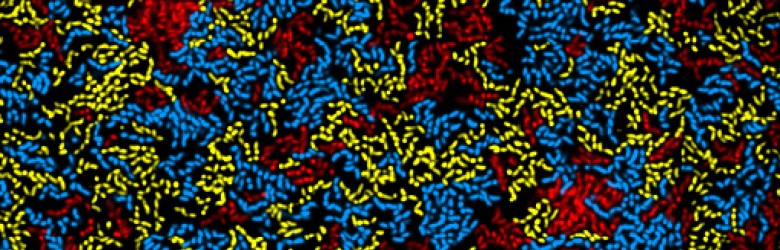
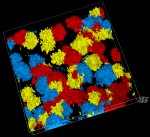
Multiple colored variants of a strain of Vibrio cholerae (a causative agent of cholera in human hosts) co-inoculated on glass. The variants express 3 different fluorescent proteins that enable visualization of the contribution of each to biofilm formation. One optical slice at the base of a biofilm is shown in two of these images, while the 3-D volume snapshot was rendered using a z-stack of optical slices of the biofilm. Biofilm formation can affect virulence and persistence of this important human pathogen.
Day: October 10, 2014
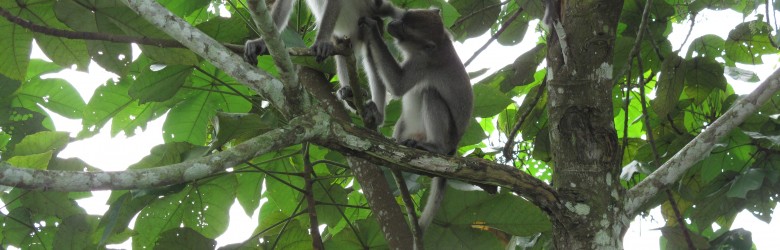
Long-tailed macaques in Borneo
These monkeys host arboviruses as well as the primate malaria species Plasmodium knowlesi which can also infect humans. Key determinants of whether macaques and people share parasites include proximity of human habitation to the forest, the location and feeding preferences of mosquito vectors, and relative susceptibility of the host species. Zoonotic reservoirs like these can play a major role in the evolution and persistence of parasites. And for species of conservation concern, parasites can have an important effect on likelihood of extinction.